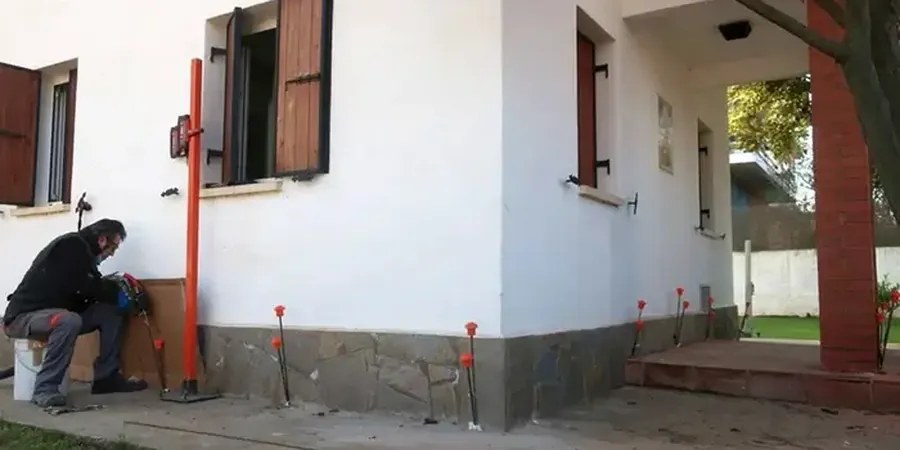
Mackay sits on deep alluvial deposits from the Pioneer River, with soft estuarine clays reaching over 15 meters in some areas. These compressible layers make differential settlement a real risk for buildings and infrastructure across the city. A thorough differential settlement analysis here starts with understanding the site’s stratigraphy and the load distribution from the proposed structure. Before finalizing foundation design, engineers often pair this assessment with an ground investigation program to obtain reliable soil strength parameters and a consolidation test to evaluate time-rate behavior of the compressible layers.
Differential settlement analysis in Mackay routinely reveals 25-50 mm of total settlement over 10-15 meter spans in Pioneer River floodplain clays.
Methodology and scope
Soil conditions vary widely between North Mackay, with its firmer residual profiles, and the southern suburbs near the river, where soft clays dominate. A differential settlement analysis in Mackay must account for these local variations. The process typically involves:
Borehole drilling and undisturbed sampling at depths down to bedrock
Laboratory oedometer tests following AS 1289.6.6.1 to measure consolidation characteristics
Numerical modeling using Plaxis or Settle3D to compute differential movements
The team then compares predicted settlements against allowable limits from AS 2870 for residential slabs or AS 4100 for steel structures. This data-driven approach helps select appropriate foundation solutions tailored to Mackay’s specific ground conditions.
Technical reference image — Mackay
Local considerations
The risk of differential settlement in Mackay is highest in the reclaimed lowlands near the harbor and along the Pioneer River floodplain. These areas contain soft clays with high moisture content and low bearing capacity. Without a proper analysis, the structure may experience uneven foundation movement, leading to cracked walls, jammed doors, and misaligned steel frames. The team uses the measurement of consolidation parameters from oedometer tests and numerical modeling to quantify risk and recommend mitigation strategies such as ground improvement or deeper foundations.
Targeted analysis for single dwellings, townhouses, and small commercial buildings. Includes 2-3 boreholes, oedometer testing, and settlement calculations to AS 2870. Typical turnaround is 5-7 working days.
02
Industrial & Infrastructure Settlement Study
Comprehensive evaluation for warehouses, bridges, and large fill embankments. Involves multiple boreholes, advanced consolidation testing, and finite element modeling. Reports include settlement contours and construction recommendations.
Applicable standards
AS 1726:2017 Geotechnical site investigations, AS 2870:2011 Residential slabs and footings, AS 1289.6.6.1 Methods of testing soils – Consolidation test
Frequently asked questions
What causes differential settlement in Mackay soils?
The main causes are compressible alluvial clays, variable fill thickness, and localized changes in groundwater levels. In Mackay, the Pioneer River floodplain clays are particularly prone to consolidation under load, leading to non-uniform ground movement.
How is differential settlement measured and predicted?
Field boreholes with undisturbed sampling provide soil specimens for oedometer tests. The consolidation parameters (Cc, Cr, cv) are input into settlement analysis software. Engineers then calculate total and differential settlement under design loads, comparing results against allowable limits from AS 2870 or AS 4100.
What is the typical cost range for a differential settlement analysis in Mackay?
For a standard residential site, the cost ranges between AU$1,200 and AU$3,170, depending on the number of boreholes, laboratory tests, and reporting requirements. Larger infrastructure projects may exceed this range.