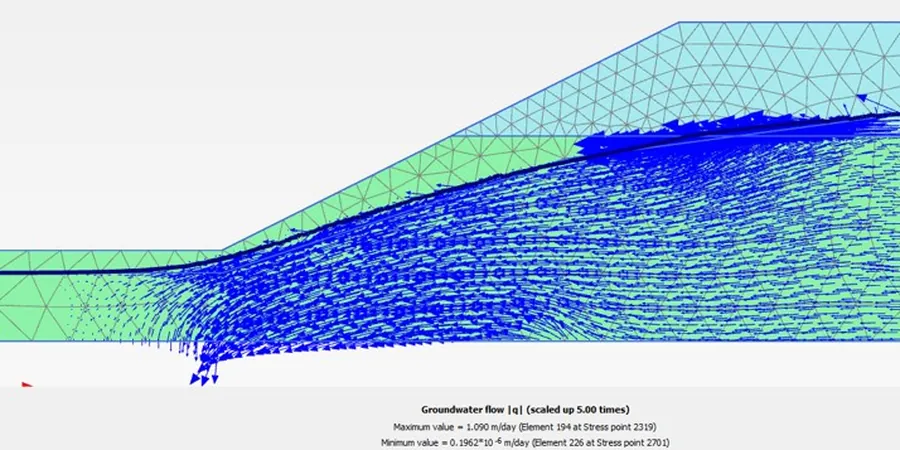
Mackay's subtropical climate and proximity to the Pioneer River mean many developments sit on residual soils overlying basalt or alluvial deposits. A common pattern we see is shallow translational slides along the soil-rock interface after prolonged rainfall events. Slope failure analysis in Mackay must account for perched water tables developing within the first 3–5 metres after heavy downpours. We combine field reconnaissance with numerical modelling to identify critical slip surfaces, using a classification of soils to characterise the colluvium and saprolite layers that dominate the region's hillsides.
Shallow translational slides along the soil-rock interface are the dominant failure mode in Mackay's basalt-derived residual soils after sustained rainfall.
Methodology and scope
Our analysis follows AS 4678:2002 for earth-retaining structures and AS 1726:2017 for site investigation. For Mackay's typical slopes, we apply limit equilibrium methods (Bishop simplified, Spencer, and Morgenstern-Price) alongside finite element codes when strain-softening behaviour is expected. Key parameters include drained shear strength from consolidated-drained triaxial tests, unit weight from undisturbed block samples, and pore pressure response modelled using SEEP/W under rainfall infiltration scenarios. We also incorporate the influence of root reinforcement on shallow stability for slopes supporting native vegetation along the Pioneer Valley escarpments.
Technical reference image — Mackay
Local considerations
Mackay lies in a moderate seismic zone (AS 1170.4 hazard factor Z ≈ 0.08), so earthquake-induced instability is secondary to rainfall-triggered failures. The primary risk is rapid undrained loading of residual soils during cyclonic events, which can reduce available shear strength by 30–40% within hours. We have documented cases where filling on the upslope side of a property without subsurface drainage triggered progressive failure extending 20 metres beyond the loaded area. Slope failure analysis in Mackay must also consider the risk of debris flows channelling through existing drainage lines after the first major storm of the wet season.
Bishop, Spencer and Morgenstern-Price methods for circular and non-circular slip surfaces using SLOPE/W and Slide. We calibrate parameters against Mackay's residual soil database.
02
Finite Element Modelling
Plaxis 2D and RS2 models for strain-softening soils, progressive failure, and soil-structure interaction. Particularly useful for slopes adjacent to existing infrastructure.
03
Rainfall Infiltration Modelling
Transient seepage analysis with SEEP/W to predict pore pressure build-up during design storm events (1% AEP, 72-hour durations typical for Mackay).
04
Probabilistic Risk Assessment
Monte Carlo simulations to quantify probability of failure under variable groundwater and strength conditions, supporting cost-benefit decisions for stabilisation works.
Applicable standards
AS 4678:2002 – Earth-retaining structures, AS 1726:2017 – Geotechnical site investigations, AS/NZS 1170.4:2007 (Amdt 1) – Structural design actions (earthquake), FHWA-NHI-10-027 – Rock slopes and soil slopes (reference method)
Frequently asked questions
What is the difference between limit equilibrium and finite element methods for slope stability?
Limit equilibrium methods (e.g., Bishop, Spencer) compute the factor of safety by balancing driving and resisting forces along an assumed slip surface. They are fast and widely accepted for routine design. Finite element methods model stress-strain behaviour throughout the slope, capturing progressive failure, soil-structure interaction, and pore pressure redistribution. For Mackay's strain-softening residual soils, we often use FE to assess whether a local slip can propagate into a global failure.
How much does a slope failure analysis cost in Mackay?
A typical slope failure analysis for a residential or commercial site in Mackay ranges between AU$1.230 and AU$4.340, depending on the number of cross-sections, the complexity of groundwater conditions, and whether numerical modelling is required. The lower end covers a single limit equilibrium section; the upper end includes multiple FE models with rainfall infiltration and probabilistic assessment.
Which AS standards apply to slope stability design in Mackay?
The primary standard is AS 4678:2002 for earth-retaining structures, which covers slope stability requirements. AS 1726:2017 governs site investigation and soil classification. For seismic loading, AS/NZS 1170.4:2007 defines the earthquake hazard (Z ≈ 0.08 for Mackay). We also reference the FHWA-NHI-10-027 manual for detailed analysis guidance.
What factor of safety is required for slope failure analysis in Mackay?
For static long-term conditions under AS 4678, a factor of safety of 1.3–1.5 is typical for permanent slopes, depending on consequence category. For temporary cuts or rapid drawdown scenarios, 1.1–1.2 may be acceptable. Seismic cases (AS 1170.4) use 1.1–1.2. We always discuss target factors with the certifying engineer based on site-specific risk.
Can slope failure analysis be done without drilling boreholes?
A preliminary assessment can rely on surface mapping, test pits, and geophysical surveys (e.g., MASW, resistivity). However, for any slope with potential to affect structures or public safety, we recommend at least one borehole or test pit per slope to obtain undisturbed samples for triaxial testing and to confirm groundwater conditions. In Mackay's residual soils, hand augers rarely penetrate below 2–3 metres, so machine drilling or excavator pits are usually necessary.