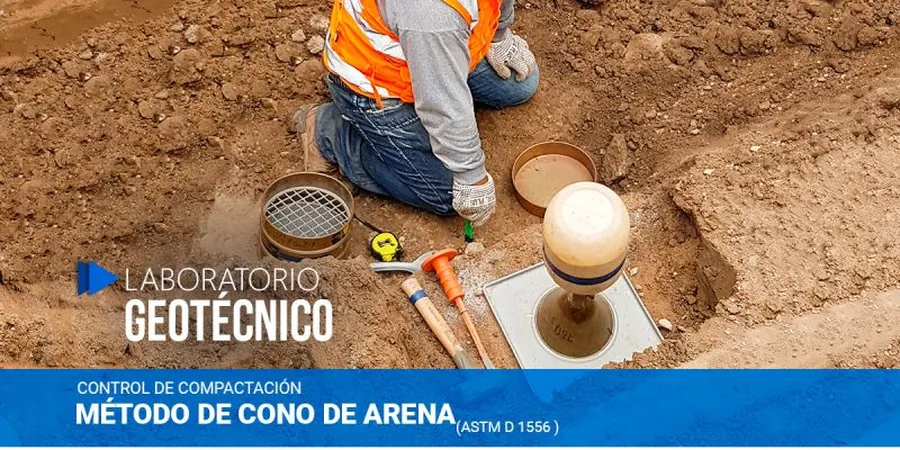
We roll up with a sand cone apparatus, a field balance, and a supply of clean dry sand. On site in Mackay, the first step is always the same: we level the test area, seat the base plate firmly, and dig a cylindrical hole exactly 100 mm deep. The extracted soil is bagged, weighed, and dried in our portable oven. Mackay's subtropical climate means near-surface moisture fluctuates fast — we record water content on the spot. The volume of the hole is determined by filling it with calibrated sand from the cone. This gives us the in-situ density. We then compare that against the Proctor maximum dry density from our lab to calculate percent compaction. It is a direct, repeatable method that requires no radioactive source and no permits. For deep fills or difficult access, we often combine this with a plate load test to verify bearing capacity at the same elevation.
In Mackay's variable subgrades, the sand cone method catches weak layers that nuclear gauges miss in uneven terrain.
Methodology and scope
We follow AS 4678:2002 for earth-retaining structures and AS 3798:2007 for earthworks compaction control. In Mackay, the dominant soils are sandy clays and residual silts derived from the local sedimentary rock. These materials compact differently depending on moisture at the time of rolling. The sand cone test captures that variability. We run the test at multiple depths — typically at 150 mm intervals — to ensure the full lift is compacted, not just the surface. The method is ideal for cohesive fills, road subgrades, and trench backfill. Before placing structural fill, we recommend a Proctor compaction test on the same material to establish the reference density. All results are reported within 24 hours, with moisture content, dry density, and percent compaction clearly tabulated.
Technical reference image — Mackay
Local considerations
The most common mistake we see in Mackay earthworks is compacting too wet. The sand cone test catches it immediately — the wet density looks fine but dry density is low because of excess water. Contractors then try to fix it with more passes, but the damage is structural. The clay particles reorient under high pore pressure and the soil loses shear strength permanently. We have also seen cases where the fill was placed in 400 mm lifts instead of the specified 200 mm. The sand cone at depth exposed the soft core that the surface roller had sealed over. That kind of defect is invisible without the test. A single field density test can save weeks of rework and tens of thousands in remedial costs.
Same-day preliminary results; written report within 24 h
Associated technical services
01
Standard Sand Cone Density Test
Full in-situ density testing for road subgrades, structural fills, and trench backfill. Includes moisture content determination and percent compaction calculation against Proctor reference. Suitable for clay, silt, sand, and gravel soils up to 50 mm particle size. Results delivered within 24 hours.
02
Nuclear Gauge Verification (Supplementary)
For high-volume earthworks, we cross-check sand cone results with a nuclear density gauge. The gauge provides rapid readings, but we always back it with sand cone tests for acceptance. This hybrid approach is common on Mackay subdivision and industrial pad projects.
Applicable standards
AS 1289.5.3.1 (Sand replacement method), AS 3798:2007 (Earthworks compaction control), AS 1289 (Standard test method for density and unit weight of soil in place by sand cone)
Frequently asked questions
How does the sand cone method work for field density testing in Mackay?
We dig a small cylindrical hole, weigh the extracted soil, and determine its volume by filling the hole with calibrated sand from a cone-shaped apparatus. The in-situ dry density is then compared to the Proctor maximum dry density to calculate percent compaction. The entire process takes about 20 minutes per test.
What is the typical cost for a field density test in Mackay?
A standard sand cone test with moisture content and compaction report ranges between AU$150 and AU$240 per test point. Volume discounts apply for projects with more than 10 test points. Costs include site visit, equipment setup, soil drying, and a certified report.
How many field density tests are needed per earthworks lift?
AS 3798 recommends a minimum of one test per 200 m² per lift for major fills, and one per 500 m² for general earthworks. In Mackay, we typically test every 250 m² to account for the variable moisture content of local sandy clays. The engineer of record may specify a higher frequency.
Can the sand cone method be used on coarse gravel or rock fill?
It works best on soils with particles up to 50 mm. For larger aggregates, the hole method becomes inaccurate because the sand cannot fill the voids reliably. In those cases, we recommend a nuclear gauge or a large-scale replacement test (e.g., balloon density method).