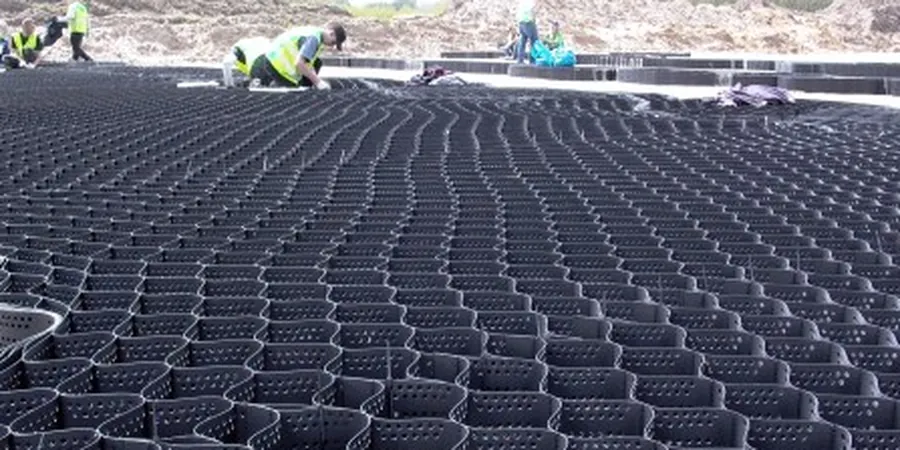
The heavy summer rainfall in Mackay, averaging over 1,600 mm annually, saturates the region's alluvial and coastal clay soils. These conditions often leave construction sites with very low bearing capacity. A properly designed geocell system creates a stiffened composite layer that spreads wheel loads and prevents rutting on temporary access roads or permanent earthworks. Before any geocell layout is finalised, we run site-specific lab tests to confirm soil strength and moisture content. The final design integrates these results to match the right cell height, weld spacing, and infill material. Complementing this with a study of expansive soils helps anticipate volume changes in reactive clays, while a plate load test verifies the achieved modulus on site.
A geocell-reinforced layer can triple the load distribution angle compared to unreinforced aggregate, reducing vertical stress on soft subgrades by over 50 %.
Methodology and scope
Mackay's soil profile varies notably between the northern industrial precincts and the southern residential areas. The northern zone often presents soft estuarine clays up to 6 m deep, whereas the southern side shows firmer residual silts. For access roads or laydown yards in the northern sector, geocell design focuses on limiting differential settlement through a stiffened granular layer. In the southern sector, the main challenge is erosion control on sloping fills. The design process includes:
Site classification per AS 2870 and AS 1726
Selection of cell geometry based on subgrade CBR
Infill specification (crushed rock versus recycled concrete)
Connection detailing for panel edges
Each project receives a calculation report with a factor of safety against bearing failure and a predicted rut depth for the design traffic.
Technical reference image — Mackay
Local considerations
Coastal Mackay lies within a zone of moderate seismic activity, with a peak ground acceleration of 0.08 g according to AS 1170.4. While this is not extreme, the combination of soft alluvial soils and a shallow water table — often less than 2 m below ground — creates a risk of liquefaction-induced settlement during a seismic event. A geocell design that does not account for this pore pressure build-up may suffer lateral spreading. We model the confining effect of the geocell using an equivalent cohesion approach, then check the reinforced layer against static and seismic sliding. This dual-check ensures the system remains stable even under cyclic loading.
Boreholes and test pits to classify subgrade material per AS 1726, including moisture content, Atterberg limits, and CBR testing.
02
Geocell specification & layout design
Selection of cell geometry, infill gradation, and panel configuration based on traffic load, subgrade strength, and drainage requirements.
03
Structural calculation & reporting
Bearing capacity analysis, rut depth prediction, and sliding stability checks. Report includes design assumptions and construction tolerances.
04
Construction support & verification
On-site inspection during geocell placement and infilling, followed by plate load tests to verify the achieved modulus and load distribution.
Applicable standards
AS 4678 – Earth-retaining structures, AS 1726 – Geotechnical site investigations, AS/NZS 1170.4 – Structural design actions (earthquake)
Frequently asked questions
How does geocell design differ from traditional aggregate base in Mackay's soft clays?
Unreinforced aggregate on soft clays (CBR < 3) typically requires a base thickness of 400–600 mm to avoid rutting. A geocell-reinforced layer achieves the same performance with 200–300 mm, reducing imported fill volume by up to 40 %. The confinement also prevents lateral spreading of the aggregate, which is common in Mackay's wet subgrades.
What is the typical cost range for a geocell design in Mackay?
For a standard access road or laydown pad (500–2,000 m²), the geocell design including site investigation, calculations, and construction support typically ranges between AU$1,420 and AU$3,830. Final pricing depends on site access, extent of testing, and design complexity.
Can geocells be used for slope protection on Mackay's canal banks?
Yes. Geocell systems are widely used on canal banks and drainage channels in the Mackay region. The cells are filled with topsoil and hydroseeded, or with rock armour where wave action is expected. Design must account for rapid drawdown conditions and the low cohesion of the native silts.
What infill material is recommended for geocells on Mackay's wet subgrades?
Crushed rock (20–40 mm nominal size) with less than 5 % fines is preferred to maintain drainage. Recycled concrete aggregate can be used where available, provided it meets the same gradation and durability criteria. For permanent installations, we also recommend a geotextile separator beneath the geocell to prevent subgrade pumping.