Mackay sits on the Pioneer River floodplain with deep alluvial clays, silty sands, and occasional gravel lenses extending 15–25 m below surface. Groundwater sits 2–4 m deep across most of the urban area. These conditions demand a thorough soil mechanics study before any foundation design, whether for a beachfront development on Harbour Road or a commercial building near the airport. We combine borehole drilling, SPT profiling, and laboratory classification to define both the strength and compressibility of the underlying strata. A typical investigation also includes in-situ permeability testing to assess drainage around subsurface structures, plus consolidation tests on undisturbed samples to predict long-term settlement under load.
In Mackay's alluvial clays, a soil mechanics study is the only reliable way to separate safe bearing layers from settlement-prone zones before pouring a single foundation.
Methodology and scope
We recently completed a soil mechanics study for a six-storey apartment block on the eastern side of Mackay near the sugar terminal. The site featured soft to firm clay underlain by dense sand at 18 m depth. Our investigation followed AS 1726 with continuous SPT at 1.5 m intervals and undisturbed tube sampling in cohesive layers. The key parameters we delivered included:
Undrained shear strength from UU triaxial tests on clay strata
Effective friction angle from CD tests on sand layers
Compression index (Cc) and recompression index (Cr) for settlement analysis
Site subsoil class per AS/NZS 1170.4 for seismic design
We also ran Atterberg limits on the clay horizons to flag potential shrink-swell behaviour, since Mackay experiences seasonal rainfall swings from 100 mm in winter to 350 mm in summer.
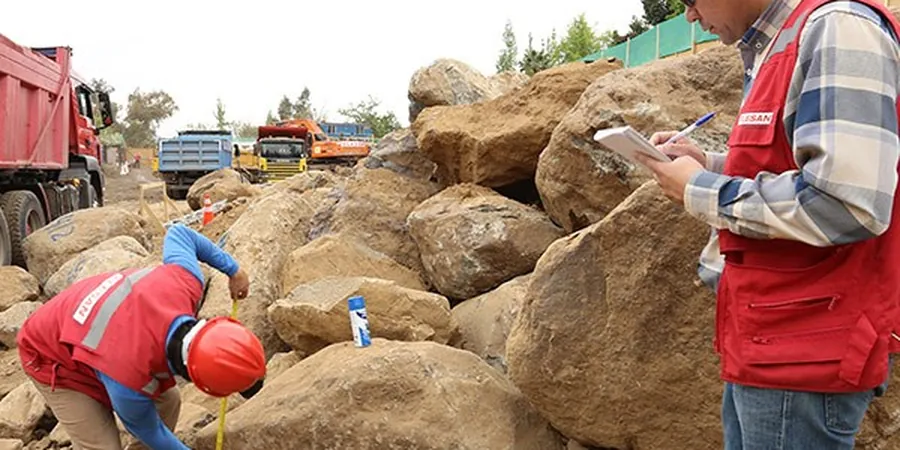
Technical reference image — Mackay
Local considerations
Mackay's tropical climate delivers over 1,600 mm of rain annually, with most falling between December and March. This seasonal saturation can soften the upper clay crust and reduce bearing capacity by 30–50% if construction happens during the wet season. The alluvial clays also exhibit moderate to high plasticity, meaning they shrink and crack during dry months and swell when rewetted. A soil mechanics study that includes moisture content profiles and swell pressure testing helps you avoid slab heave in the dry zone or differential settlement under a heavy load. We always flag these risks in our reports so the structural engineer can design accordingly.
We drill boreholes to depths of 25 m using a track-mounted rig. SPT at 1.5 m intervals gives continuous N-values to identify soft zones, dense layers, and the bearing stratum.
02
Undisturbed Sampling & Laboratory Testing
Thin-wall tube samples from cohesive layers allow us to run triaxial, consolidation, and Atterberg tests. For granular soils we use split-spoon samples for sieve and Proctor tests.
03
Site Classification & Foundation Design Parameters
We classify the site per AS 1726 and AS/NZS 1170.4, then deliver allowable bearing pressures, settlement estimates, and seismic site class for the structural engineer's use.
04
Slope Stability & Excavation Assessment
For sites near the Pioneer River or on cut slopes, we model shear strength parameters to determine safe excavation angles and recommend temporary shoring if needed.
Applicable standards
AS 1726 – Geotechnical Site Investigations (2017), AS/NZS 1170.4 – Structural Design Actions (Earthquake) (2007), AS 1289.6.3.1 – Standard Test Method for Standard Penetration Test (SPT), AS 1289.3.1.1 – Standard Test Methods for Liquid Limit, Plastic Limit, and Plasticity Index
Frequently asked questions
How much does a soil mechanics study cost in Mackay?
For a standard residential site with 2–3 boreholes to 10 m depth, expect to pay between AU$4,980 and AU$9,220 depending on access, number of laboratory tests, and report detail. Commercial sites with deeper bores or specialised testing sit at the upper end.
What is the difference between N-SPT and bearing capacity in Mackay clays?
N-SPT measures the resistance to driving a split spoon into the soil, giving a direct index of density and strength. Bearing capacity is an allowable stress derived from that N-value combined with soil type, groundwater, and foundation geometry. In Mackay's soft clays an N-value of 5 may translate to an allowable bearing pressure around 80–100 kPa after applying the relevant safety factor.
When should I order a soil mechanics study for my Mackay project?
Order it as soon as you have a preliminary site layout, ideally before finalising the structural design. The results feed directly into foundation type, slab thickness, and drainage requirements. For sites near the river or on filled land, early testing avoids costly redesigns after construction starts.