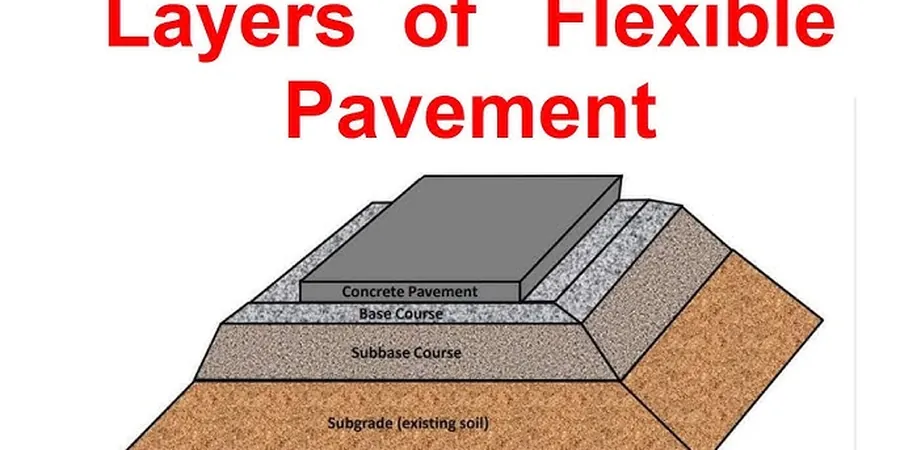
In Mackay, we see plenty of heavy haulage roads serving the sugar and mining industries, and they chew up poorly designed pavements fast. Getting the flexible pavement design right starts with understanding the local subgrade — we have logged CBR values below 3 percent in the alluvial flats near the Pioneer River, which demands a thicker base or stabilisation to avoid premature failure. Our team runs soaked and unsoaked CBR tests per AS 1289.6.1.1, and we couple that with field density checks using the sand cone method to confirm compaction levels on site. Before committing to a structural number, we also recommend a subgrade investigation to map weak zones across the alignment, because a single spot test never tells the full story in these variable floodplain soils.
In Mackay's alluvial flats we have logged CBR values below 3 percent, demanding thicker base layers or stabilisation to avoid premature pavement failure.
Methodology and scope
We design flexible pavements following Austroads Guide to Pavement Technology Part 2 (AGPT02-17), using traffic loading data from the client and applying a 95 percent confidence level for reliability. The laboratory sequence includes Atterberg limits, particle size distribution, modified compaction (AS 1289.5.2.1), and repeated load triaxial testing for the granular base materials when the design speed exceeds 80 km/h. For Mackay's wet season, we pay close attention to the soaked CBR and the swell percentage — values above 1.5 percent can indicate reactive subgrades that require lime treatment or a capping layer. Where the pavement sits on low-lying terrain near the coastline, we integrate geotextile separation layers into the design to prevent pumping and migration of fines into the granular base, a common failure mode in this region.
Technical reference image — Mackay
Local considerations
A common scenario we see in Mackay is a new industrial subdivision built on the floodplain west of the Bruce Highway. The contractor places 200 mm of granular base over a subgrade that looked firm during the dry season, then the first heavy rain hits and the base disappears into the mud. That happens when the subgrade CBR drops below 2 percent after saturation and the design did not account for the perched water table at 1.2 metres depth. Our flexible pavement design includes a drainage layer and a minimum 300 mm select fill to raise the pavement formation above the wet season water table, which directly reduces the risk of shear failure in the subgrade and limits future rutting.
150 mm for light traffic, up to 400 mm for heavy haul
Design reliability
85% – 95% per Austroads AGPT02
Associated technical services
01
Subgrade CBR and Material Characterisation
Soaked and unsoaked CBR testing, Atterberg limits, particle size distribution, and modified compaction to classify subgrade materials and determine design CBR values.
02
Resilient Modulus (Mr) Testing
Repeated load triaxial tests on granular base and subbase materials per Austroads AGPT-T053, providing modulus inputs for mechanistic-empirical pavement design.
03
Pavement Structural Design Report
Layer thickness design using CIRCLY or equivalent software, including traffic loading analysis, drainage recommendations, and selection of asphalt or granular surfacing.
Applicable standards
Austroads Guide to Pavement Technology Part 2 (AGPT02-17), AS 1289.6.1.1 — Determination of the California Bearing Ratio (CBR), AS 1289.5.2.1 — Compaction control test (Modified compaction), AS 1726 — Geotechnical site investigations
Frequently asked questions
What is the typical cost range for a flexible pavement design study in Mackay?
For a standard road or car park project, expect to invest between AU$2.640 and AU$8.250 depending on the number of test pits, CBR tests, and traffic loading scenarios analysed. Larger industrial haul roads with multiple pavement sections can exceed that range.
How many CBR tests are required for a pavement design in Mackay?
Austroads recommends a minimum of three CBR tests per pavement section for homogeneous subgrades, and at least one test per 200 metres for variable alluvial soils common in Mackay. Our lab typically runs soaked CBRs on the 95 percent and 100 percent compaction curves to capture the full range.
Can you design a flexible pavement for a heavy haulage road carrying 100-tonne loads?
Yes. We have designed pavements for sugar cane haul routes and mine access roads in the Mackay region. The design accounts for ESALs up to 10^8, using a granular base of 350-400 mm and a cement-treated subbase where the CBR drops below 5 percent.
Do you include drainage recommendations in the pavement design report?
Absolutely. Every report includes a drainage chapter covering subgrade drainage, edge drains, and the required depth to the water table. In Mackay's wet tropics we always specify a minimum 300 mm freeboard above the wet season water table to protect the pavement structure.