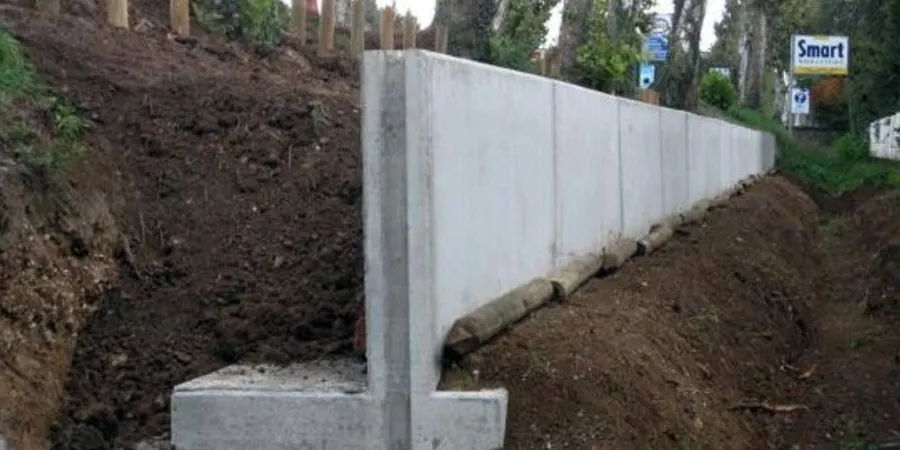
Mackay sits on the Pioneer River floodplain, where the water table can rise within 2 meters of the surface after heavy rain. That shallow groundwater directly affects retaining wall design in Mackay — drainage becomes critical, and lateral pressures from saturated soils increase significantly. We see a lot of sites where the backfill turns into a slurry during a wet season. That is why every project starts with a proper site investigation. Before we touch the wall geometry, we run a permeability field test to estimate flow rates through the soil mass. The numbers then feed into the drainage layer design. The goal is simple: prevent hydrostatic buildup behind the wall. Mackay's subtropical climate demands that level of detail.
In Mackay, shallow groundwater and reactive clays make drainage design as important as structural design for retaining walls.
Methodology and scope
Mackay's geology alternates between alluvial clays and coastal sands, sometimes in the same block. Each layer behaves differently under load. The clays shrink and swell depending on moisture content — we have measured plasticity indices above 40% in some subdivisions. That kind of movement can crack a rigid wall in two years if the design ignores it. We also deal with soft estuarine deposits near the harbour. In those zones, the bearing capacity is low, so we often recommend reinforced soil structures instead of cantilever walls. The consolidation test on undisturbed samples tells us how long the ground will take to settle under the wall weight. For Mackay, that is usually 6 to 18 months depending on the drainage path. We combine that data with the wall type — gravity, cantilever, or anchored — to match the real ground conditions.
Technical reference image — Mackay
Local considerations
Mackay expanded rapidly from the 1970s onward, pushing residential estates onto former cane paddocks and mangrove edges. Those low-lying areas have soft compressible soils and a water table that responds to every king tide. The main risk in retaining wall design here is not the wall itself — it is the ground behind it. Poorly drained backfill builds up pressure until the wall tilts or the facing bulges. We have seen walls fail because the weep holes clogged with silt after one rainy season. The second risk is differential settlement along the wall length when the foundation straddles two different soil types. A transition zone between clay and sand can cause cracks that let water in and start internal erosion. That is why we always correlate the wall alignment with the borehole logs before finalising the design.
50 years (residential) / 100 years (infrastructure)
Surcharge load
5–20 kPa typical for vehicles / 0 kPa for gardens
Backfill type
Granular with ≤5% fines per AS 4678
Drainage layer
200 mm minimum, wrapped in geotextile
Factor of safety (sliding)
1.5 minimum (AS 4678)
Factor of safety (overturning)
2.0 minimum (AS 4678)
Associated technical services
01
Geotechnical Investigation for Retaining Walls
We drill boreholes to 5–10 m depth, log soil types, run SPT and pocket penetrometer tests, and collect undisturbed samples for laboratory testing. The result is a soil profile with strength parameters, water table depth, and consolidation characteristics. This data directly feeds into the wall design parameters.
02
Structural Design Review and Certification
Our engineers review the proposed wall type against the site conditions. We check overturning, sliding, bearing pressure, and global stability. If needed, we suggest alternatives like reinforced soil or anchored walls. The final report includes the certified design in compliance with AS 4678 and the Mackay Regional Council requirements.
Applicable standards
AS 4678:2002 Earth-retaining structures, AS 1726:2017 Geotechnical site investigations, AS/NZS 1170.2:2011 Structural design actions — wind actions
Frequently asked questions
What soil conditions in Mackay most affect retaining wall design?
Reactive clays with high shrink-swell potential are the main issue. They can exert lateral pressures far above the active pressure calculated for granular soils. Shallow groundwater adds to that by reducing effective stress and creating hydrostatic loads. We always test for Atterberg limits and water table depth before starting the design.
How much does retaining wall design cost in Mackay?
For a typical residential wall 1.5 m high and 20 m long, the geotechnical investigation and design report ranges between AU$1.380 and AU$6.660. The final cost depends on the number of boreholes, the laboratory tests required, and the wall complexity. Taller walls or those on soft ground require more investigation.
What drainage systems work best for retaining walls in this climate?
A granular drainage layer behind the wall, combined with a perforated pipe at the base, is the standard. We also specify a geotextile filter fabric to prevent silt from clogging the system. In Mackay's heavy rainfall, weep holes alone are not enough — the water volume exceeds their capacity during a cyclonic event.
Do I need council approval for a retaining wall in Mackay?
Yes. Mackay Regional Council requires a development approval for walls over 1 m high or any wall that affects drainage. The application must include a geotechnical report and a structural design certified by a registered engineer. We prepare both documents as part of our service.